By JaDarius D. Duncan
FORT BLISS, Texas — The 11th Air Defense Artillery Brigade has expanded its Fit2Fight program by training company-level facilitators to provide soldiers with injury-prevention and recovery techniques when civilian Holistic Health and Fitness professionals are unavailable.
The development follows the previously published report, “Fit2Fight Facilitator Course Hosted by 11th ADA Brigade Holistic Health and Fitness Team,” which documented soldiers from the 32nd Army Air and Missile Defense Command, 11th ADA Brigade and 1st Armored Division participating in the course at Fort Bliss.
Luke Propst, an H2F coach involved in the original training, said the program has changed since the course was first documented. Company-level facilitators can now use techniques intended to prevent injuries and improve physical readiness without requiring an H2F civilian to attend every training session.
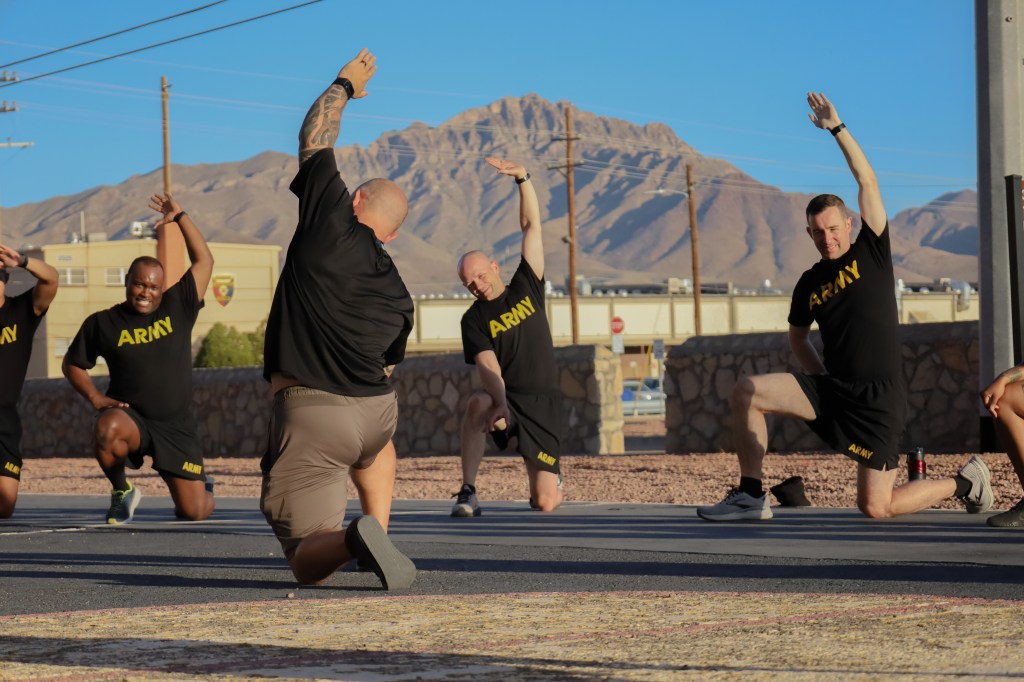
Program leaders use evaluations and tests to assess whether facilitators understand the material and can apply it within their organizations. However, Propst identified physical training for injured soldiers as one of the most difficult lessons for participants to maintain.
Leaders who have not been trained to understand a soldier’s injury may have difficulty creating appropriate exercises or applying recovery guidance, according to Propst. Continued access to H2F resources could help those leaders develop safer and more effective physical training sessions.
Command Sgt. Maj. Francisco J. Lloret Jr., the senior enlisted leader of the 11th ADA Brigade, said Fit2Fight has influenced regular unit training. Soldier medical profiles are among the evidence leaders examine when evaluating the relationship between physical training, injuries and readiness.
The brigade’s operational responsibilities make that evaluation important. The 11th ADA Brigade is the largest and most deployed air defense organization in the world, according to Fort Bliss. It belongs to the 32nd Army Air and Missile Defense Command, a theater-level organization responsible for worldwide deployment within 72 hours.
Those requirements can make balancing mission readiness and individual recovery challenging. Soldiers must remain physically prepared for training and deployment while leaders account for injuries, medical limitations and recovery needs.
Lloret identified physical training planning as a central leadership responsibility. Consistently applying Fit2Fight principles during everyday physical training could help soldiers turn the course’s lessons into long-term habits instead of practices used only when H2F personnel are present.
This follow-up used an objective process that compared Propst’s observations as an H2F coach with Lloret’s perspective as the brigade’s senior enlisted leader. Their responses were also reviewed alongside official Army information about the Fit2Fight course, the 11th ADA Brigade and the mission of the 32nd Army Air and Missile Defense Command.
Both perspectives identified leadership involvement as an important part of the program’s success. Fit2Fight has increased the number of soldiers capable of sharing injury-prevention and recovery techniques, but its long-term effect will depend on whether leaders have the training, resources and time to incorporate those principles into routine physical training.


Leave a Reply